The Kryha cipher machine
The Kryha Home Page
- Introduction (This Page)
- Iconography
- History
- Working
- Procedures
- My Simulator
- Paper emulator
- Cryptanalysis
- Kryha and CX-52
- Challenges
Presentation
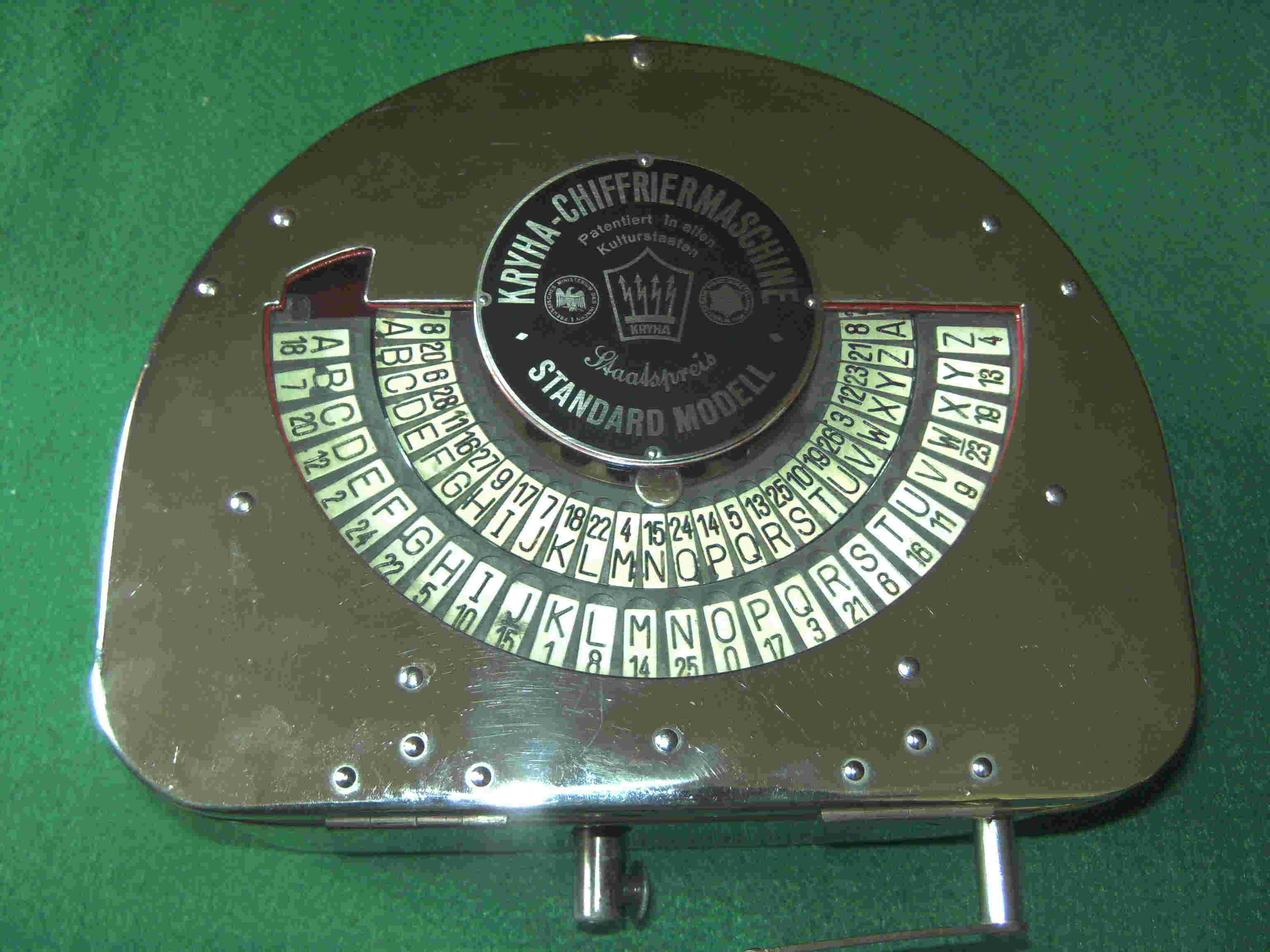
The Kryha machine is one of the very first cipher machines available to both businesses and government agencies (diplomatic and military). It dates back to the 1920s.
The most expert cryptologists quickly realized its weaknesses. However, the amateurs and even several cryptologists were able to place their trust in this machine.
Even though sales weren't spectacular, Kryha machines are not very rare. They frequently appear in auction catalogs or even directly on online marketplaces like eBay. Unfortunately, sales at the time of its production never allowed its creator (Von Kryha) to make a fortune. On the contrary, he went bankrupt.
A beautiful machine
The standard Kryha is different from other cipher machines: it is "beautiful" and "fascinating."
Let's hear from one of the greatest cryptologists in history, Frank B. Rowlett: "I found the kryha machine to be absolutely fascinating. ... It was a noisy brute of a device, giving forth an aggravationg, rasping sound folIowed by a loud click each time the control lever was depressed ... I made up my mind then and there that the study of cipher machines was the field of cryptography for me."
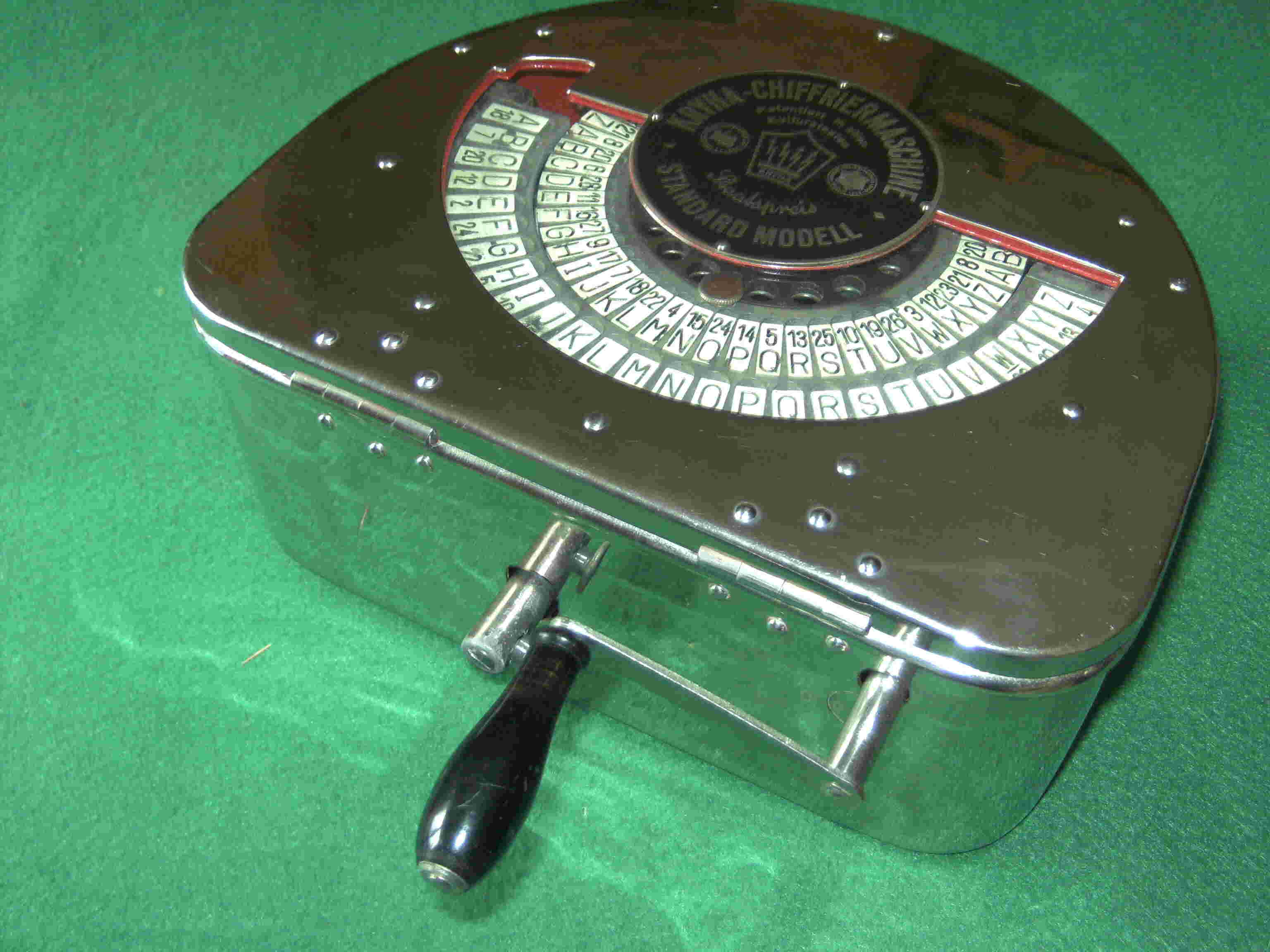
Let's also give the floor to Klaus Schmed, computer scientist and cryptography expert: "The machine looked well-designed. It was clearly influenced by the design styles Art Deco and Steamline Modernism ... The machine was delivered in a box of leather and lined with red velvet ... giving it the look of a luxury item. All this had an apperance competely different from the military look of other encryption machines (e.g. the Enigma)."
An “Unbreakable” Machine?
Most of the time, designers of cryptographic systems believe their system is unbreakable. This was also the case with Von Kryha. To support this claim, he consulted the mathematician Georg Hamel, who wrote a pamphlet calculating the number of possible keys: on the order of 10 to the power of 73. This number is enormous because the Kryha machine uses disordered alphabets. The machine was sold with a user manual and Georg Hamel's pamphlet. An amateur or novice cryptologist could easily be convinced by Hamel's claims.
On the Cryptanalysis page, it will become clear that not only the Kryha machine is not unbreakable, but it is one of the least secure cipher machines of its time.
History
The Kryha machine was created by Alexander Von Kryha, born in 1891. Of Ukrainian origin, he immigrated to Germany after the communist takeover.
In 1924, he created his first machine, which he called the "Kryha Standard." It was a mechanical machine that, from the outset, offered very little security.
The biggest deal was the sale of the Kryha license for the US to A.M. Evalenko in 1932 for $100,000. Evalenko tried to sell the Kryha to the American army but without success. The challenge he proposed to Army, was broken by Frideman and his team in 2 hours and 41 minutes (link).
Towards the end of the 1930s, he improved his machine, but it remained far inferior to competing machines (notably the Hagelin and Enigma machines). Towards the end of the war, his company ceased operations. In the 1950s, he tried again to sell the machines, but his company went bankrupt and he committed suicide in 1955.
Different models
 |
 |
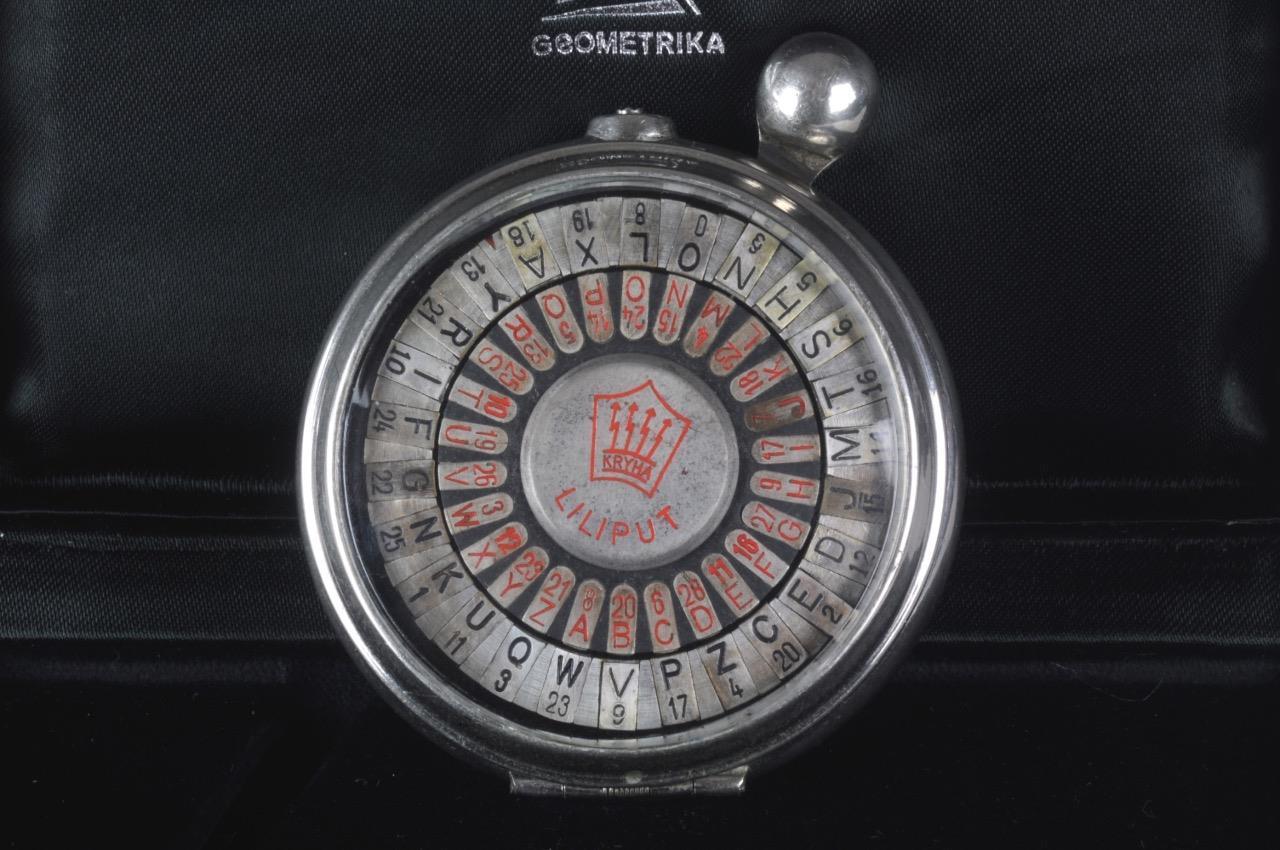 |
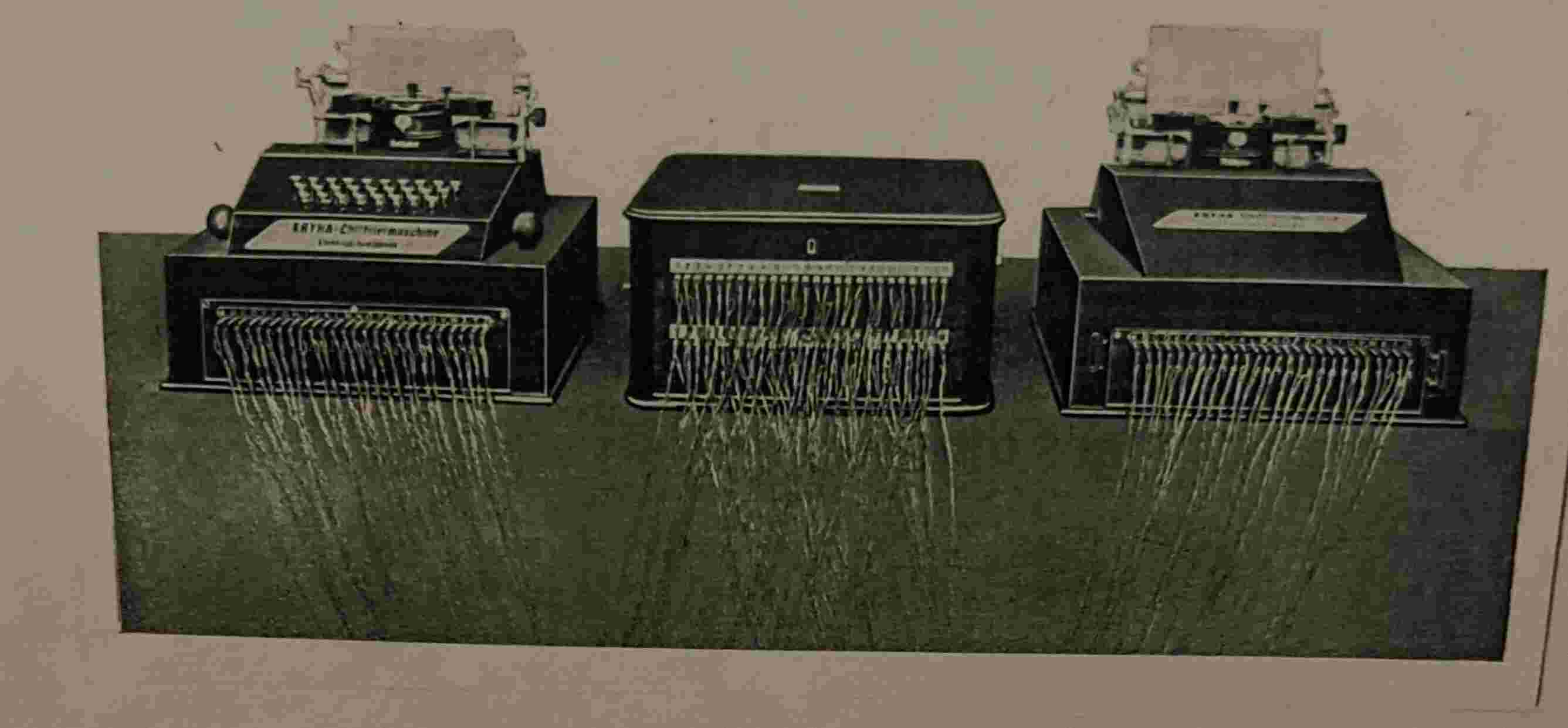
Kryha offered three versions of his machine:
- A purely mechanical version (the "standard" form) the size of a shoebox. Encrypted (or plaintext) letters were read on a dial.
- A printing version, called the Elektric model, composed of two typewriters, which served as input/output units, and a partially electrical and partially mechanical casing that performed the encryption.
- A tiny mechanical version, called Liliput, the size of a pocket watch.
We have just presented different packaging options (Standard, Liliput, Printer), but the Kryha has technically evolved. It exists in two forms, which I personally call v1 and v2. Version 1 uses a removable wheel, it is the first version (1929). Version 2 uses a single, configurable wheel. This v2 version dates from 1934 at the earliest and 1937 at the latest. Spanish nationalists ordered Kryha v2s in 1938. The Liliput model (apparently) only exists in version v2. On the Working page, we detail the operation of these models. There is also a diplomatic model, intended to be more secure and larger (with two wheels?), about which we have almost no information. See Mark's article (cf. References) to learn more about these different models.
Some characteristics
Standard Model
- Height : 5 in (12.7 cm)
- Length : 10 in (25.4 cm)
- Width : 8 in (20.32 cm)
- Weight : 160 oz (4.5 kg)
Liliput Model
- Height : 1.5 in (3.8 cm)
- Length : 6 in (15.24 cm)
- Width : 4 in (10.16 cm)
- Weight : 16 oz (450 g)
The Price of a Kryha
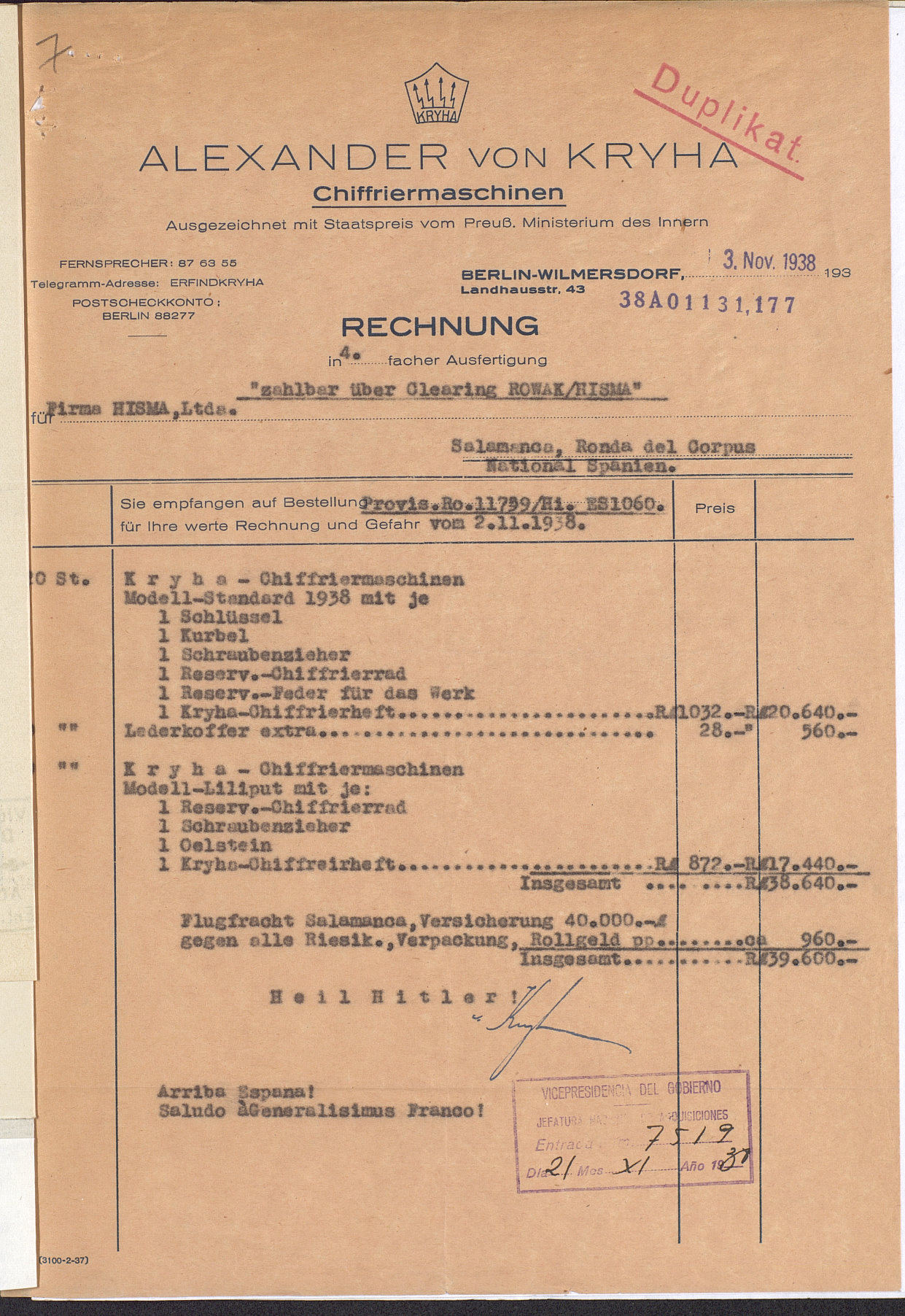
An invoice dating from 1938 (see the photo below), reveals the price of a Kryha at the time:
- Standard Kryha: 1032 RM.
- Lilliput Kryha: 872 RM.
Klaus Schmeh indicates that in the 1950s, a standard machine cost 2,000 DM (Deutschmark), the Lilliput model cost 1,600 DM, and the electric (printing) model cost between 10,000 and 20,000 DM.
For your information, $100 in 1950 is equivalent to 4.2 DM, and $100 in 1950 is equivalent to $1,350 in 2026. In short, a standard Kryha would be worth approximately $6,500 today.
Notes:
- 1) If we examine auction sales from the last twenty years, we can see that the Kryha has not increased in value, unlike the Enigma :-)
- 2) Nowadays (2026) Manufacturing a replica of the Kryha would certainly cost more than $10,000.
How many Kryha machines were manufactured?
How many Kryha machines were produced? This is a complex question. To my knowledge, there is no historical document that specifies this.
Based on serial numbers, I think between 3,000 and 6,000 machines were produced. Indeed, I have seen several v1 machines, one of which had serial number 1085. I saw another with a number around 1600 (the number is difficult to read in the photograph). I know of a v2 type machine, manufactured in July 1938, with serial number 2264. I saw another one whose serial number was 2767. Finally, another v2 machine, but with sliding stops (therefore more recent), had serial number 5101.
I don't know if the serial numbers I observed on standard models included (or not) the Liliput production.
Patents protect Kryha
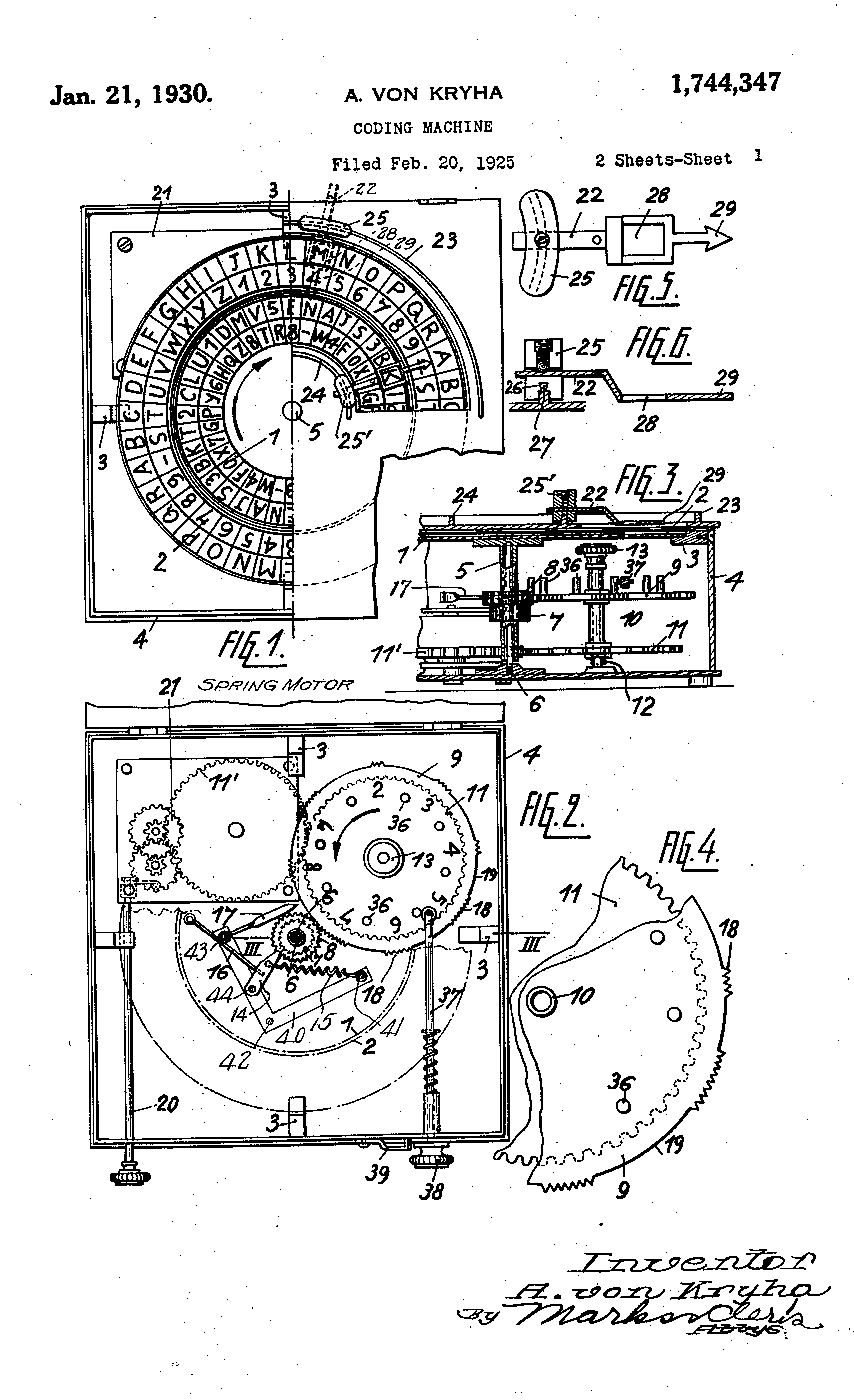
Von Kryha filed numerous patents to protect his machine starting in 1925 in the main countries equipped with cipher machines (US, France, Great Britain, Germany, Austria, Switzerland). Frode Weierud's website lists these various patents (link). The Google website describes the patent filed in the United States. (See the image above).
References
Books & Articles
-
Marks, P. 2011. Operational Use and Cryptanalysis of the Kryha Cipher
Machine. Cryptologia 35(2): 114-155.
Note: This article is the primary reference regarding the operation, use, and cryptanalysis of the Kryha machine. It is over 40 pages long, contains 44 references, and includes numerous illustrations. -
Schmeh, K. 2010. "Alexander von Kryha and his Encryption Machines."
Cryptologia 34(4): 291-300.
Note: Schemh's article describes the history of the machine and its designer. It details, in particular, Von Kryha's efforts to promote his machine, such as his collaboration with Marconi company. - Fuensanta, J. R. S. 2004. "Mechanical Cipher Systems in the Spanish Civil War", Cryptologia, 28:3. Note: The Kryha machine was one of the machines used by the Spanish forces.
- Mensajes secretos, José Ramón Fuensanta y Francisco Javier López-Brea Espiau, Tirant lo blanch, 2016.
-
Machine Cryptography and Modern Cryptanalysis, By Cipher A.
Deavours & Louis Kruh, (1985), Artech House Publishers.
Note: This book contains a chapter dedicated to the Kryha machine. It explains the operation of versions 1 and 2 and includes numerous photos. The chapter focuses on the achievement of Friedman and his team who broke a cryptogram in 2 hours and 41 minutes (see the cryptanalysis section). - Louis Kruh, 1985. "The Kryha Liliput Ciphering Machine", Cryptologia 9(3): 252–261
- The Story of Magic, by Frank B. Rowlett, Editor: Aegean Park Press, 1998.