|
Home Page Kryha Home Page
|
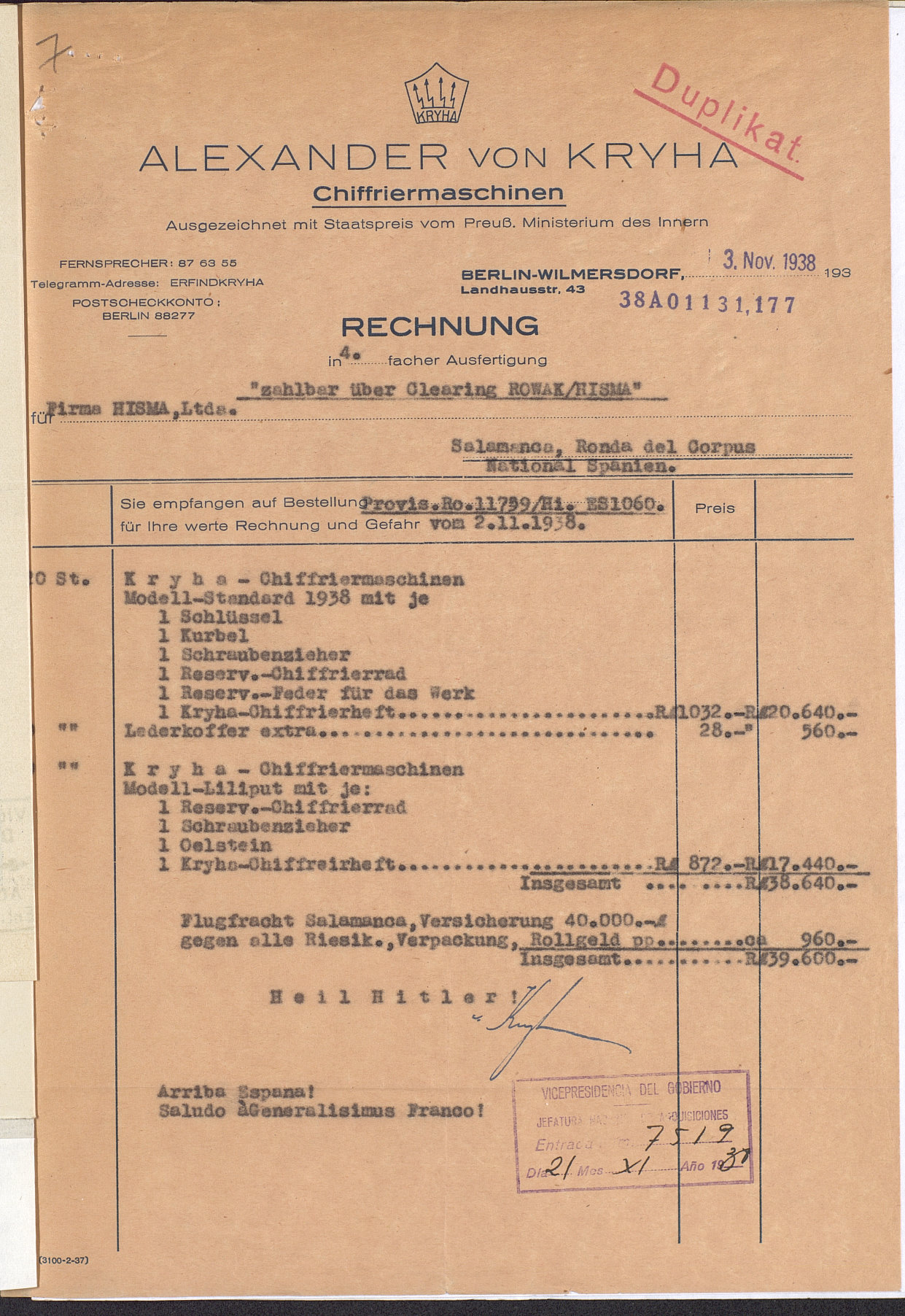
The beginningsThe Kryha machine was created by Alexander Von Kryha, born in 1891. Of Ukrainian origin, he immigrated to Germany after the communist takeover. In 1924, in Berlin, he created his first machine, which he called the "Kryha Standard." It was a mechanical machine. Between 1924 and 1929, Von Kryha developed his machine. By 1929, the standard Kryha was complete, with a stable appearance and operation. As early as 1925, Von Kryha protected his invention by filing patents in countries likely to be interested: the USA, Great Britain, France, Germany, Austria, and Switzerland. A 1928 patent shows that the machine depicted was still a prototype and did not resemble the classic standard machine. Von Kryha also tried to promote his machine. In 1926, at the police fair, his machine received the State Prize from the Prussian Ministry of the Interior. In 1928, the Kryha machine received a diploma from Dr. Konrad Adenauer at the International Press Exhibition in Cologne. The mathematician Georg Hamel, in 1927, then in 1929, wrote a pamphlet calculating the number of possible keys. This number is enormous and creates the illusion of the machine's inviolability. This brochure is distributed with the machine in addition to the manual. The Americans broke the kryhaIntroductionFrom the outset, American army cryptologists broke the kryha.Parker Hitt in 1929,1930The cipher machine Kryha was evaluated and rejected early in 1930 by the U.S. Army. The evaluation was carried out by Col. Parker Hitt. Parker's exploits: Friedman in 1931In early 1931, W.F. Friedman formed his young team within the Signals Intelligence Service (SIS), which he led. He oversaw, in particular, their research into cipher machines intended to replace codes. Among these machines, the Kryha was undoubtedly one of the most appealing. Here is Frank B. Rowlett's account: "As I recall, it was claimed that there were more than 17x26!x26! Possibilites afforded by the machine [The Hamlet’s brochure came with the machine]. In spite of these awesome figures, we were able to solve the messages of out assignment in a reasonably short time, most of which was spent in experimenting with the machine." From this testimony we can conclude that Friedman mastered the cryptanalysis of Kryha and that he was helping his team rediscover his methods. Friedman in 1933A.M. Evalenko purchased the rights to the Kryha in 1932 for $100,100 (This was thus the best deal concluded by Von Kryha). Early the following year, his lawyer, Robert C. Birkhahn, offered the Kryha system to the US Army Signal Corps. As we have seen, the Kryha machine was already studied by this department by Parker Hitt and Friedman. Evalenko persisted, and as a result, the US Army Signal Corps accepted a challenge: to break a 200-word (1,000-characters) message. The Signal Intelligence Service (SIS) carried out this mission. On February 1st, Birkhahn presented a 1,135-character cryptogram. Friedman and his team, consisting of Kullback, Rowlett, and Sinkov, found the machine's key and deciphered the cryptogram in 2 hours and 41 minutes. Needless to say, the Army, after this feat declined the offer to use the Kryha as a cryptographic tool. The Kryha v2The Kryha machine, in its early days, used a movable wheel that determined the offsets between the two alphabets (plaintext and ciphertext). From 1934 (at the earliest) to before 1938 (at the latest), another version of the Kryha appeared (I call it v2). It had a single, but configurable, wheel (see working). This innovation greatly improved the Kryha's security without making it excessively secure. Its security level, however, remained significantly lower than its main competitors, the Hagelin and Enigma machines. Kryha and The Spanish WarThe Kryha machine was used by both sides (Republicans and Nationalists) during the Spanish Civil War. The RepublicansBefore the war, the Republican government's Ministry of State (Ministerio de Estado) acquired several Liliput models. These machines were undoubtedly used by the Republican side. The NationalistsOn the other hand, it is established that the Nationalists used Kryha machines (both standard and Liliput models). Orders dating from 1938, originating from General Franco's government, attest to this. A manual describing the procedures has been found. Fuensenta informs us (see References) that Kryha machines were present in Mallorca, the Alto Estado Mayor, and Morocco. Kryha and the AbwehrAbwehr Network in Argentina (1943)IntroductionThe German networks in Argentina during World War II were organized into three networks, codenamed RED, BLUE, and GREEEN. RED was the operational network of the SD (Sicherheitsdienst), or Security Service. It focused on the political aspect and communicated with the RSHA (ReichsSicherHeitshAuptmt or Reich Security Intelligence Service) in Berlin. The RSHA controlled the Gestapo and the SD, and later even the Abwehr (German military intelligence). Radio communications between the Abwehr in Argentina and Berlin were initially encrypted using double transposition and in 1943 with the Kryha, from 1944 onwards, Enigma was used. The allies broke the Kryha trafficIn 1943 (from January to December), the RED network was encrypted with the Kryha Liliput. The US Coast Guard had broken the double transposition system used by the RED network. They also had no difficulty to brake Kryha traffic in 1943 (cf. Abwehr in Argentina). The British ere also able to read this traffic starting in May 1943 (see Marks's article). Other networksThe SD also used the Kryha machine in Italy. The ISOS (Illicit Services Oliver Strachey at Bletchley Park) team mentions a Kryha network between Berlin and Zagreb (1943-1944) (see Marks’s article). Trade relations between Nazi Germany and the Spanish NationalistsDuring the Spanish Civil War, German aid to the Nationalists (Operation Feuerzauber) was channeled through a Spanish-German company called HISMA (HISpano-Marroqui de Transporte) and later through SOFINDUS (SOciedad FINanciera inDUStrial). These entities acted as a front for the German company ROWAK (ROhstoffe-und-WAren-einKaufsgesellschaft). This opaque aid amounted to approximately three million Reichsmarks. Trade continued after the war ended. Note: On the homepage, an invoice for Kryha machines purchased by nationalists in 1938 was presented. This invoice was indeed paid by the ROWAK/HISMA consortium. A 1942 document from American army cryptanalysts describes encrypted exchanges between entities belonging to the aforementioned companies. These exchanges used Kryha v1 encryption machines equipped with a standard 17-sector wheel. The Kryha was used to over-encrypt a public code (the Rudolf Mosse commercial code). Another document, dating from 1943, indicates the use of Kryha v2 and improved security procedures. References: Mark’s article and Weierud’s web site. A sad endingEven though the Kryha machine was improved before World War II, it remained far inferior to competing machines, especially Hagelin machines. Toward the end of the war, The Kryha company ceased operations. In the 1950s, Von Kryha tried again to sell his machines. He approached various German organizations, including the Foreign Ministry, but without success. He also tried to find customers in America. He traveled through the USA, Brazil, Argentina, Colombia, and Venezuela. He returned to Germany without having made a single sale (see Schmeh’s article). His company went bankrupt, and Von Kryha committed suicide in 1955. ReferencesBooks & Articles
Web sites |